
INKLUSI LOGO Full Color Stacked - English

Implementing Partners

Bakti Foundation

Bakti Foundation Logo

About BaKTI Foundation

Yayasan Bursa Pengetahuan Kawasan Timur Indonesia (BaKTI Foundation) is a civil society organisation focused on knowledge exchange and strengthening the capacity of development actors in Eastern Indonesia.

Through INKLUSI, BaKTI Foundation partners with local CSOs to address violence against women and children, improve access to social protection for persons with disabilities and other marginalised groups, and establish Constituency Groups (Kelompok Konstituen/KK) at the village level that are connected to local legislatures, government agencies, and the media.
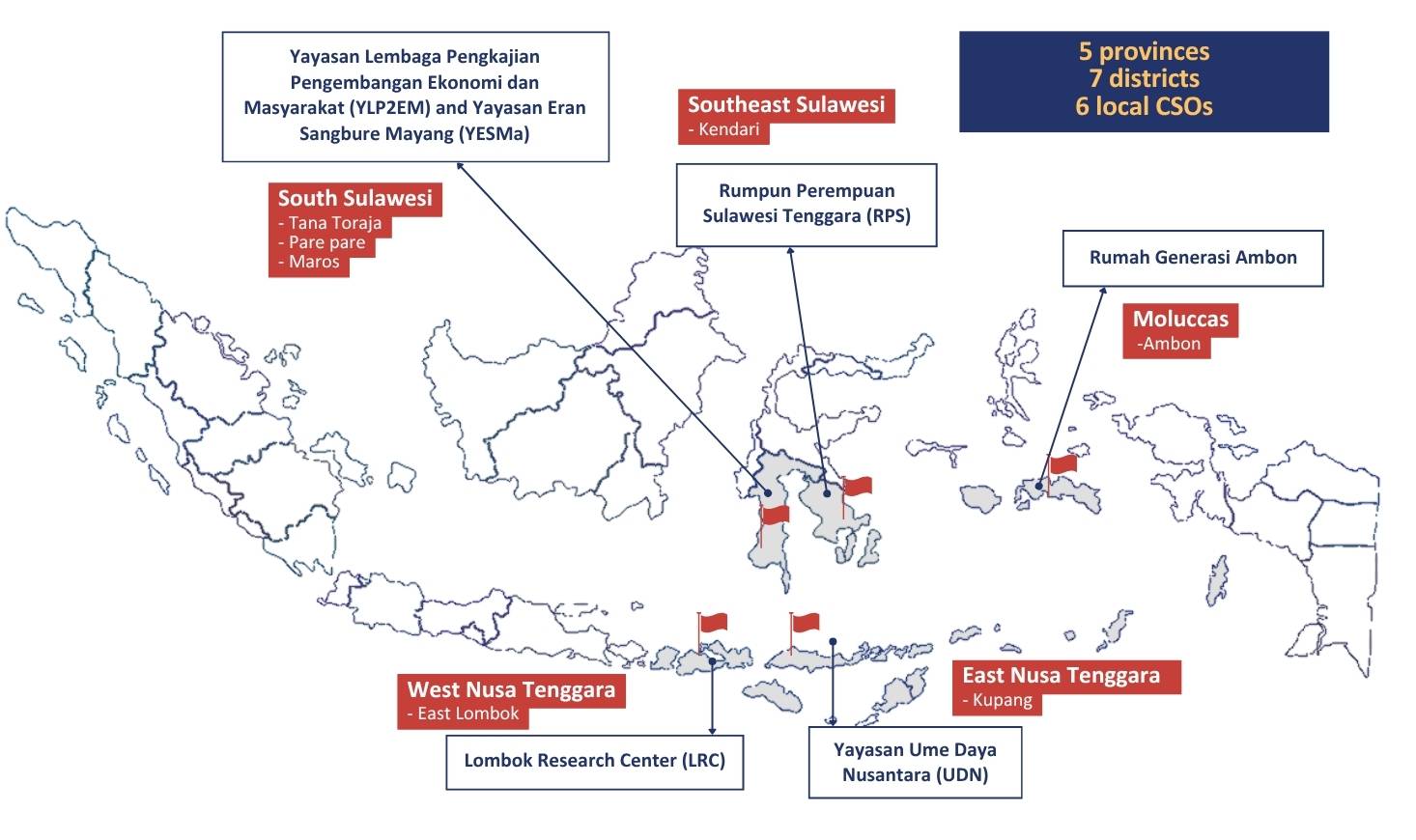

Partners and Working Area

Activities

Establishment and Strengthening of Constituent Groups (KK)

Strengthening community networks at the village and sub-village levels, comprising religious leaders, community leaders, women cadres, youth, persons with disabilities, older people, and other marginalised groups, to advance policy advocacy, inclusive programmes, access to social services, and protection for survivors of violence.

Policy and Government Program Advocacy

Supporting the acceleration of inclusive services by promoting the integration of gender and inclusion perspectives into government and local parliament policies, programmes, and budgets. BaKTI also supports Musrenbang processes focused on women, children, persons with disabilities, and older people, as well as initiatives such as Inclusive Villages, Child-Friendly Villages, Women-Caring Villages, Law-Aware Villages, Inclusive Schools, and Inclusive Posyandu.

Participatory Recess

Bringing together constituents and marginalised groups, including women, persons with disabilities, and minority groups, to voice their aspirations and needs in shaping more inclusive policies and programmes.

Media Forum for Inclusive News Coverage

Establishing media forums at the district/city level to promote inclusive and ethical reporting. BaKTI works with AJI and PWI to strengthen journalists’ capacity to produce gender-responsive, child-friendly, and inclusive reporting.

Encouraging Inclusivity in Universities

Working with universities to promote inclusive academic policies and practices through research, community service programmes on inclusion and the SDGs, and the establishment of campus task forces for the prevention and handling of sexual violence.

Disability Forum

Promoting the establishment of district/city-level forums to strengthen the voice, participation, and advocacy of persons with disabilities, while also serving as spaces for sharing information and collaborative solutions.

Programme Focus

Victim of violence services for women and children.
Social protection services for women, children, marginalised, and other vulnerable groups in the program areas.

Programme Strategies

Organising and strengthening the capacity of the constituent groups (KK)
Strengthening policy advocacy and technical support to government.
Strengthening the roles of members of parliament
Involving the media to produce inclusive news
Involving universities in creating an inclusive society

Expected Outcomes

Women, children, people with disabilities, and vulnerable groups who are victims of violence receive services and protection;
Provision by the government of affordable and quality social services for women, children, people with disabilities, and other vulnerable groups;
Strengthened multistakeholder collaboration in the protection and fulfillment of the rights of vulnerable groups
BAKTI Photo Banner

Achievements as of December 2025

840

case facilitators from 7 districts/cities have an identity card as a case facilitator. The identity card is mandated by the decree letter from the Child Protection Office (DP3A) for facilitators of violence cases, and Social Office for facilitators of social protection.

>13,884

Marginalised people have accessed services provided by community-based groups supported by INKLUSI.

>15,920

marginalised people have accessed government services and other external services.

1,800

marginalised people have participated in the public decision-making processes/forums at sub-village, village, subdistrict, and district/city level.

74

individual business units owned by KK member's business groups have been established and operate with INKLUSI’s support.

143

marginalised people became members of the community-based business units that had been established and in operation.

Development of Disability Groups:

  • Established disability forums/groups at the district level.
  • Established and expanded 20 disability groups at the village level equal to other institutions.

Advocating for Inclusive Policies:

Supporting and encouraging inclusive policies at the local level, such as the RAD-PD, Perda, and policies on Inclusive Village and Manpower Local Services Unit (ULD), such as the RAD-PD in South Sulawesi, Toraja, Parepare, and Ambon.

Education and Inclusive School Local Services Unit (ULD):

  • Education ULDs have been established in Toraja, Maros, and Kendari.
  • Mapping processes have been carried out for inclusive education that resulted in regulation, data of the special need students, qualification of teachers/instructors, types of disability, and infrastructures.
  • There have been policies from the office (Dinas) heads, district chiefs (bupati)/mayors to support the implementation of inclusive schools in Maros and Kendari.
  • SMPN 2 (Junior High School 2) Kendari serves as the pilot inclusive school that has allocated budgets to purchase assisting devices for special needs students, taken from the BOS fund.
  • In Maros, technical guidance (juniors) for enrolling students in Maros District has been issued through a decree of the Head of Education and Cultural Office of Maros District. The technical guidance is aligned with the District Chief’s Regulation on Inclusive Education. The technical guidance stipulates that there is an affirmative quota of 20% that should be applied to students with disability.
  • Two policies of the Head of Education Office of Kendari City and Maros District have been issued regarding PPDB, which stipulates that all schools including preschool, kindergarten, elementary school, and junior high school must accept children with special needs as students.

Community-based Service:

  • Developing community-based services (LBK) in villages for the protection of and handling violence cases against marginalised people.
  • Fostering the Integrated Service Unit for Women and Child Protection (UPTD PPA).
  • Supporting the establishment of UPTD PPA in 7 districts/cities to help women and children with disabilities who are victims of violence.

Advocacy and Referral Mechanism for Violence Cases:

  • Collaborating to develop a mechanism for violence case referral, including violence against people with disabilities.
  • Strengthening the Taskforce of Sexual Violence Prevention and Handling (Satgas PPKS) in various universities in 5 provinces.

Disability Service Unit (ULD) for Employment:

  • Establishing and optimising the ULDs in Ambon, Maros, East Lombok, and Kupang.
  • Partnership with the private sector and universities (Novotel Makassar, Alfamart, Alfamidi, and PT Adira Finance) for the provision of formal employment and internship opportunities.

Participation and Budgeting:

  • Encouraging participatory recess and village budgeting for education and increasing the skills of people with disabilities in several districts/cities.
  • Establishment of the Local Disability Commission in Maros District to oversee the implementation of inclusive programs.

Encouraging the development of inclusive villages:

  • Up to the present, the achieved 9 indicators of the inclusive village according to the INKLUSI Program intervention framework in 102 BaKTI’s beneficiary villages are as follows:
  • 31 villages (23 villages, 8 kelurahan) in 7 districts/cities that have met at least 5 of the 9 indicators/criteria of an inclusive village
  • 18 villages meet 4 indicators/criteria of an inclusive village.
  • 35 villages have village regulations on inclusive village and ones that include indicators of inclusive village in 7 locations.
  • 102 villages/kelurahan (all beneficiary villages) have segregated data on vulnerable groups and people with disabilities.

Subscribe to INKLUSI Newsletter

Sign up for INKLUSI's newsletter to stay updated on our programs and advocacy efforts. Together, we can build a more inclusive and equitable society!