


In many households across East Sumba, the kitchen is still widely regarded as women’s domain. Cooking for the family, preparing food for customary ceremonies, serving guests and ensuring everyone is fed are responsibilities that often fall disproportionately on women.
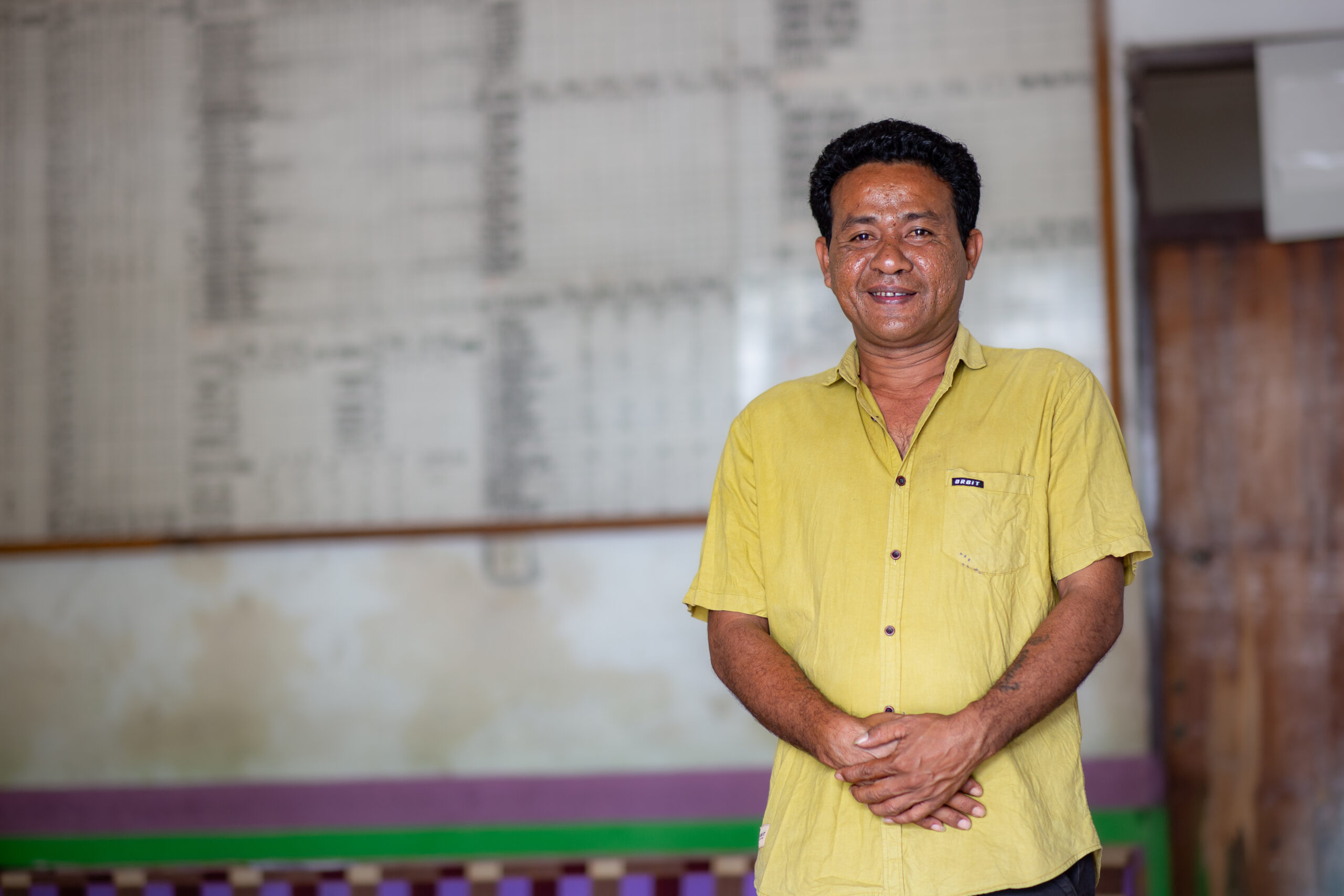
So when Yohanis K. Maramba Hamu says that he can now cook, it may sound like a simple statement, but it carries considerable meaning. The Head of Mbatakapidu Village in East Sumba regularly shares photos and videos of himself cooking on social media.
“This is not about image-building. It is about education,” he said during an INKLUSI visit to the village in May. “For me, social media is a space where we can encourage people to discuss village issues more openly.”
For Yohanis, men entering the kitchen is not simply about helping their wives. It is a practical way to challenge prevailing ideas about the roles of women and men. Change, he believes, cannot only be discussed at village meetings or written into regulations. It must begin with everyday habits.
“Women carry the greatest burden during customary ceremonies because they are expected to cook and take care of so many things,” said Yohanis, 43, whose wife is a civil servant.
Like many villages in East Sumba, Mbatakapidu faces multiple, interconnected challenges. Its territory is extensive, many households remain economically vulnerable, customary practices continue to shape daily life, women’s participation still needs to be strengthened, and access to basic services is uneven.
Since 2023, the village, which has a population of around 1,600 people, has received support from Lembaga Bumi Lestari (LBL), an INKLUSI partner in East Sumba. This support includes the empowerment of women and persons with disabilities, strengthening farmers’ groups, managing savings and loan initiatives, and community organising.
For Yohanis, LBL’s presence did not mark the beginning of change. Rather, it became a catalyst that helped ideas he had considered for years move forward in a more focused way.
One shift can be seen in how the village supports its residents. Instead of providing assistance to individuals, it now places greater emphasis on strengthening groups. Mbatakapidu has 27 farmers’ groups, including three women farmers’ groups. Through mentoring, these groups have learned to improve their administration, manage financial reporting and understand their role as spaces for collective learning.
“Financial administration has improved, and the groups have become more accountable,” Yohanis said.
Women’s economic activities have also begun to expand. Woven crafts and ikat textiles are no longer limited to traditional products such as mats. A two-by-one-metre mat, which usually sells for around IDR80,000 to IDR100,000, can be turned into several laptop bags or mobile phone pouches with a higher combined value.
For a village such as Mbatakapidu, developing these skills is an important step towards strengthening household economies.
Village Leadership and Custom
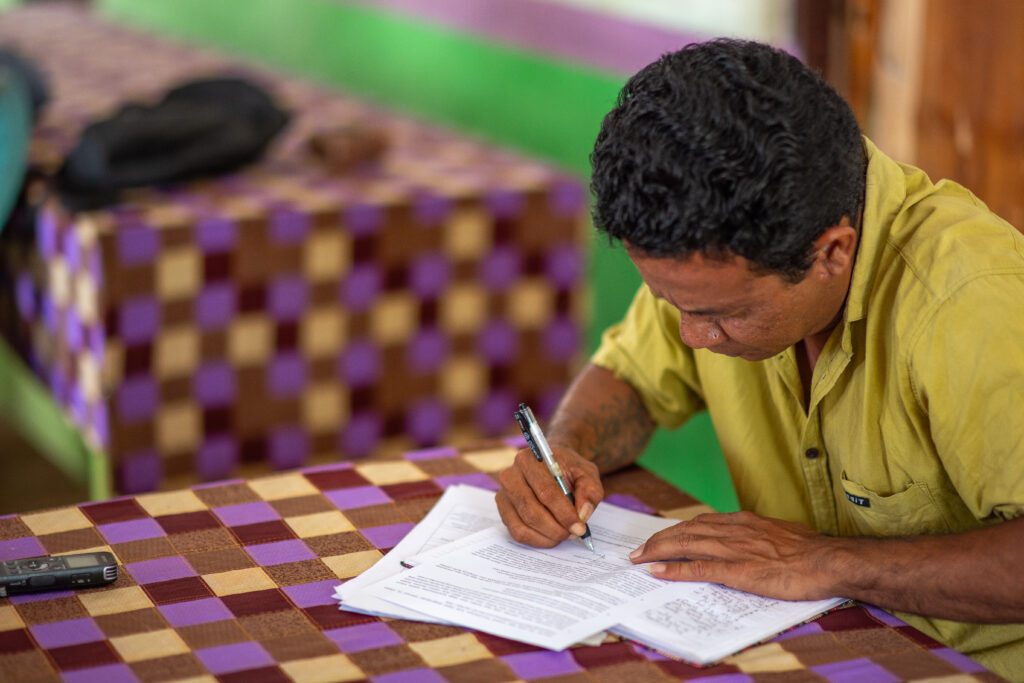
One of Yohanis’s strongest convictions concerns adat, or customary traditions. He does not reject them. Instead, he believes customary practices must be open to discussion when they begin to place excessive burdens on residents.
“Custom can protect us,” he said. “But if it is not managed, it can also make us poor.”
He points to funeral practices as an example. A grieving family must not only cope with the loss of a loved one but also shoulder substantial social and economic responsibilities. Customary funeral ceremonies can last at least two days. The family is expected to provide food and, when community members return home, give them pork to take with them.
Families that cannot afford these obligations may postpone the ceremony for years or take out bank loans to cover the costs. In such circumstances, traditions intended to strengthen solidarity can instead deepen economic vulnerability.
Yohanis has therefore encouraged the development of a village regulation to simplify certain customary practices. The process has been community-led: engaging customary communities, consulting traditional leaders, developing a shared understanding and building consensus.
He also recognises that change cannot be achieved by one village alone.
“There is little point if only one village changes,” he said. “If Mbatakapidu changes while neighbouring villages continue with the old practices, our residents will still face the same pressures.”
Yohanis hopes the district government can support and coordinate this effort so that other villages can also adapt their practices.
Mbatakapidu is also mapping customary land to reduce communal disputes between clans. For Yohanis, clarifying boundaries and rights over communal land is essential to ensure that custom does not become a source of conflict but remains a foundation for living together.
Customary community issues are also linked to the recognition of Marapu adherents, who accounted for approximately 30 per cent of the village population, or around 490 people, in 2025. Since their beliefs have been formally recognised in civil registration documents, accessing public services has become easier.
“When people’s identities are recognised, administrative processes become much simpler,” Yohanis said. “They are no longer made to face unnecessary difficulties because of their beliefs.”
Women in East Sumba Belong at the Decision-Making Table
Change in Mbatakapidu can also be seen in the growing presence of women in village forums. According to Yohanis, women now account for around half of the participants in village development planning meetings. They represent the Family Welfare Empowerment organisation, farmers’ groups, women farmers’ groups and other community organisations.
This increase did not happen automatically. The village government encouraged neighbourhood leaders to ensure that women aged 17 and above were invited to decision-making forums.
For Yohanis, women must be involved because they experience the direct effects of village decisions, from food security and household finances to children’s education and customary responsibilities.
“If women are only asked to cook, village decisions will be unbalanced,” he said.
LBL’s support has helped strengthen this process through joint savings and loan groups, farmers’ groups and administrative capacity-building. The savings and loan groups are particularly important because they offer an alternative to high-interest daily loans. As reductions in Village Fund allocations limit the village’s financial capacity while urgent needs remain, group funds can provide residents with a safer and more accessible financial buffer.
Protecting women has also become a priority. In 2025, Mbatakapidu developed a Village Head Regulation on domestic violence. The regulation was introduced across the village’s 12 community units to prevent violence against women and strengthen community responses.
Yohanis emphasises that not every case of violence should be addressed through customary mediation or treated as a private family matter.
“If it is violence, it must not be concealed as a household issue,” he said.
This distinction is important in a context where problems within families are often handled behind closed doors. Through the regulation, Mbatakapidu has begun to distinguish between disputes that may be mediated and violence that requires protection and support for survivors.
The village has also developed an integrated, community-based child protection mechanism. Within families, Yohanis promotes changes in men’s roles through weekly fatherhood classes. These classes provide a space for men to discuss parenting, domestic responsibilities and their roles at home.
Planning for the Long Term
Mbatakapidu faces significant development challenges following budget efficiency measures that have reduced the village’s fiscal space. The village has three primary schools, one kindergarten and one early childhood education centre. However, according to Yohanis, none of them has yet received the government’s Free Nutritious Meals programme.
To attend junior secondary school, children must travel to Waingapu, around two hours away by motorbike or car.
Against this backdrop, Mbatakapidu is developing a local food programme. In every hamlet, the village is encouraging demonstration plots for local crops and the processing of ingredients such as cassava and bananas.
LBL has also supported research into cassava and banana chips, which could eventually be distributed to schools as locally produced food alternatives while reducing children’s consumption of ultra-processed foods.
Yohanis remembers a childhood in which cassava and other local foods were part of everyday meals.
“We used to eat cassava, and our bodies were stronger,” he said. “Now children eat instant noodles and tire easily.”
Building food resilience, however, is not straightforward. Local food crops are frequently eaten by free-roaming livestock. Food programmes must therefore be accompanied by better land management, changes to livestock-rearing practices and the development of markets for local products.
Another source of economic pressure is African swine fever, which has killed pigs across the area. In Sumba, pigs are not only economic assets but also an important part of social and customary life. A large pig can be worth around IDR8 million. When one dies, a family may lose its most valuable form of savings.
“The death of a single pig can bring a family down,” Yohanis said.
For Yohanis, village development therefore cannot be limited to physical infrastructure. Villages also need systems that make residents more resilient: strong economic groups, revitalised local food systems, protection for women and children, recognition of customary communities, and regulations that reduce excessive burdens on families.
Ultimately, Yohanis’s leadership is reflected not only in the village regulations he has promoted, but also in his willingness to open conversations about issues often considered sensitive: customary practices that place excessive demands on families, violence hidden behind closed doors, women’s limited participation and men’s long-standing distance from domestic work.
Through his actions in the kitchen, he demonstrates that change does not always begin with grand interventions. Sometimes, it begins with a village head having the courage to do something once dismissed as “not a man’s responsibility”.
“If we want residents to change, we must start with ourselves,” Yohanis said. “We cannot simply stand in front of people and talk. We have to set an example.”