Jakarta, 25 September 2026 – Welfare data plays an important role in ensuring that social protection assistance reaches people according to their needs. Beyond decile rankings, information on the circumstances and vulnerabilities of individual household members can provide a more comprehensive picture of household welfare.
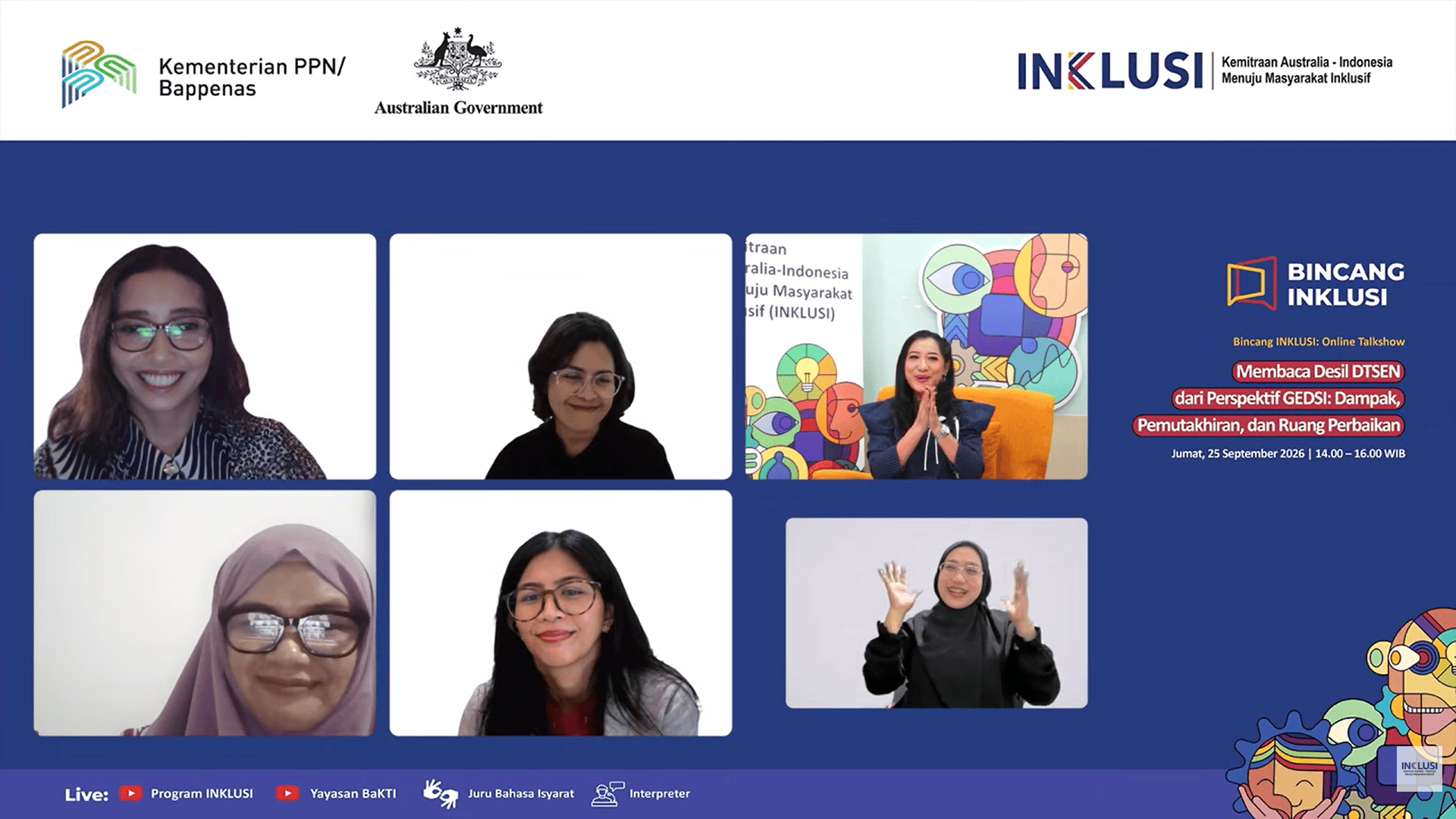
This was the focus of Bincang INKLUSI: Reading DTSEN Deciles through a GEDSI Lens: Impacts, Data Updates, and Opportunities for Improvement, an online talk show that brought together perspectives from government, academia, researchers, and civil society organisations. The discussion explored how the National Single Socioeconomic Data (Data Tunggal Sosial dan Ekonomi Nasional, DTSEN) can be used through a gender equality, disability, and social inclusion (GEDSI) lens.
Diah Hadi Setyo Naluri, a lecturer and researcher at the Demographic Institute of the Faculty of Economics and Business, University of Indonesia, explained that deciles estimate household welfare levels based on several indicators, including housing conditions, water sources, cooking fuel, assets, and household composition.
According to Diah, although disability is included as a variable, the decile classification method considers consumption, while households with members with disabilities may face additional needs.
“Expenses for therapy, assistive devices, transportation, and support services are among the costs that need to be considered when assessing household welfare,” she said.
She added that similar circumstances can affect women who head households and own inherited property but have no stable income. Asset ownership and the ability to meet daily needs must be considered together to gain a more comprehensive understanding of household circumstances.
Complementing DTSEN Decile Rankings with Vulnerability Information
Dwi Rahayuningsih, Head of the Disability, Older Persons, and Care Economy Inclusivity Team at the Ministry of National Development Planning/National Development Planning Agency (Bappenas), emphasised the importance of linking decile rankings with information on individual vulnerabilities.
“Two households in the same decile may have different vulnerabilities,” Dwi explained.
Households with members with disabilities or older persons, for example, may face different expenditure needs and barriers to accessing services than other households. Information on age, gender, and disability can complement welfare rankings and help inform the provision of appropriate services.
Community support experiences also illustrate these needs. Siti Zahara, Programme Coordinator at Rumpun Perempuan Sultra (RPS), reported that her organisation received 41 complaints related to social protection from communities across 20 assisted urban wards in Kendari City in 2026.
The complaints included inactive participation in the BPJS Health Contribution Assistance scheme (Penerima Bantuan Iuran, PBI) and the discontinuation of assistance through the Family Hope Programme (Program Keluarga Harapan, PKH), Non-Cash Food Assistance (Bantuan Pangan Non-Tunai, BPNT), and the Indonesia Smart Card (Kartu Indonesia Pintar, KIP).
According to Siti, changes in access to assistance affect household spending on healthcare, education, food, and other basic needs. These experiences provide insights into residents’ circumstances and can inform follow-up action through existing mechanisms.
Regular data updates are therefore important, as household circumstances can change over time. Job loss, illness, disasters, or changes in household composition can affect people’s needs and their ability to meet basic necessities.
Strengthening Data Updates through Collaboration
Raden Roro Endah Noorwidayati explained that the Ministry of Social Affairs provides several channels for checking and updating data, including through village or urban ward administrations, the Cek Bansos application, and the ministry’s complaints channels.
Endah also explained the use of a positive list approach, which allows assistance to be provided based on specific vulnerabilities rather than relying solely on decile rankings. Considerations include emergencies, disasters, and social welfare issues that have yet to be addressed.
“The Ministry of Social Affairs also considers vulnerability to help reduce inclusion and exclusion errors in the data. This approach supports efforts to improve the accuracy of assistance targeting,” Endah said.
Andrea Adhi, an independent public policy researcher, added that cross-sector collaboration can help build a more comprehensive understanding of people’s needs. The needs of persons with disabilities, for example, are diverse and extend beyond healthcare services.
“Connecting data and services across the social, health, education, and employment sectors can support these efforts. Sectoral data, regional data, and information from communities can also complement one another to provide a fuller picture of people’s circumstances,” Andrea said.
Andrea further noted that, to make data updates more accessible, implementation must take regional conditions and people’s access to information into account. In areas with limited internet connectivity, services through village or urban ward administrations, alongside direct assistance, remain important.
Through this dialogue, INKLUSI provided a platform for exchanging knowledge and experiences to support more inclusive use of DTSEN. Collaboration among government, academia, and civil society can strengthen data updates and help connect people with social protection that responds to their needs.