

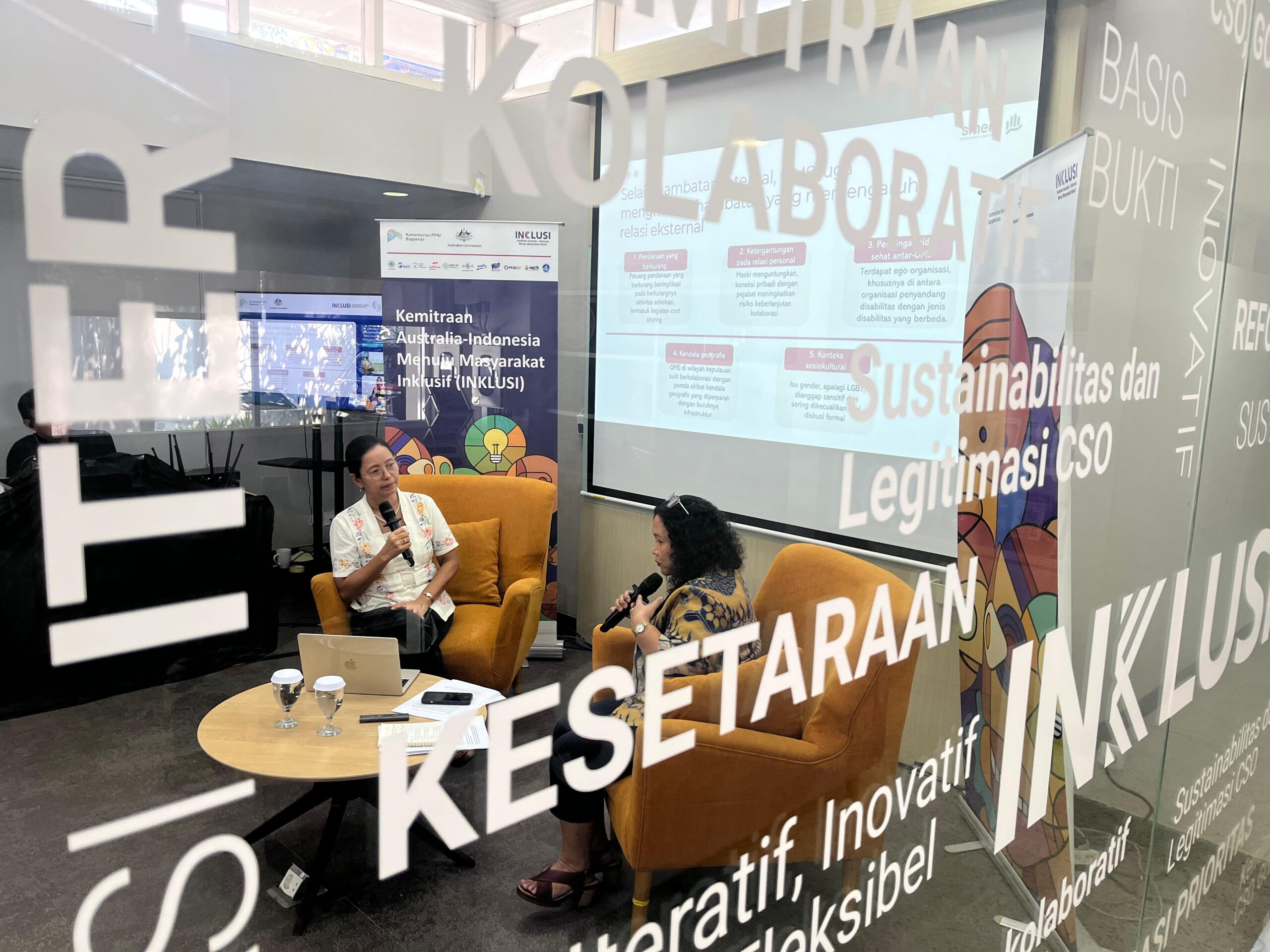
Jakarta, 10 July 2026 – INKLUSI and the Australia–Indonesia Partnership for Accelerating Basic Services (SKALA) brought together civil society organisations and program stakeholders to discuss stronger collaboration with government in mainstreaming gender equality, disability and social inclusion (GEDSI) in regional planning and budgeting.
The discussion took place during an INKLUSI Brown Bag Lunch (BBL) titled “From Research to Practice: Strengthening Civil Society–Government Collaboration for GEDSI Mainstreaming”. Held in a hybrid format at the INKLUSI Secretariat, the event was attended by civil society organisation (CSO) partners from INKLUSI and SKALA.
The discussion focused on the findings of the “Baseline Study on Multi-Stakeholder Collaboration for Mainstreaming Gender Equality, Disability and Social Inclusion in Indonesia”. The study found that CSOs have valuable assets for advancing inclusive development, including direct experience working with communities, local knowledge, disaggregated data and networks at different levels.
The study was initiated by the Directorate of Family, Parenting, Women and Children at the Ministry of National Development Planning/Bappenas, conducted by The SMERU Research Institute and supported by SKALA.
Published in November 2025, the study examined CSO institutional capacity and collaboration between CSOs and provincial governments in mainstreaming GEDSI through regional planning and budgeting processes. The research was conducted in Aceh, North Kalimantan, Gorontalo, Maluku, West Nusa Tenggara and East Nusa Tenggara, involving representatives of CSOs and provincial governments.
Several INKLUSI CSO partners working in these provinces contributed to the study by sharing their experiences and perspectives on collaborating with government and promoting policies and services that are more responsive to the needs of marginalised groups.
Moderated by Ulfa Kasim from the KAPAL Perempuan Institute, the discussion provided a space for partners to explore the study’s findings, reflect on their experiences and consider how the findings could support stronger GEDSI mainstreaming at the regional level.
The Strategic Role of CSOs in Mainstreaming GEDSI
Palmira Permata Bachtiar, a researcher at The SMERU Research Institute, explained that the study covered five key areas: institutional governance for GEDSI, the CSO landscape in inclusive development, CSO participation in regional planning and budgeting, trust between CSOs and government, and CSO institutional capacity.
The findings indicate that CSOs have several strengths that enable them to contribute to GEDSI mainstreaming. These include their experience working directly with communities, understanding of regulations, access to grassroots data, and networks with development partners, universities, philanthropic organisations and faith-based institutions.
“CSOs draw strength from the knowledge and data they gain through their direct work with communities. These assets are critical for bringing the needs of vulnerable groups into planning and policymaking processes,” Palmira said.
This knowledge and data can help ensure that the needs of women, people with disabilities and other marginalised groups are not overlooked in development processes. Their contribution is particularly important as governments continue to face limitations in collecting, managing and analysing disaggregated data.
In practice, data collected by CSOs is often used to support the planning and delivery of services that are more responsive to community needs. One example comes from Flower Aceh, a local partner of PERMAMPU.
When information about vulnerable groups in disaster situations remained dispersed across different government agencies, Flower Aceh conducted disaggregated data collection at the village level. Village authorities subsequently used the data to support disaster responses that were more accurate and responsive to the needs of vulnerable groups.
This experience demonstrates that GEDSI mainstreaming depends not only on the existence of policies, but also on the availability of data, an understanding of the different needs of community groups, and the ability to translate inclusion principles into planning and public services.
Moving from Policy to Implementation
During the discussion, INKLUSI partners shared their experiences of the challenges involved in translating GEDSI policies into practice at the regional and village levels. They highlighted the importance of access to planning and budgeting documents, the availability of disaggregated data, and support to translate community input into technical planning processes.
Participants also discussed the need for participation that goes beyond formal consultation. CSOs and community groups need to be meaningfully involved from the identification of needs and the development of plans and budgets through to the monitoring of policy and service implementation.
In this context, the role of CSOs is not to replace government, but to bring community experiences, needs and voices into development processes. For this contribution to be effective, it requires relationships built on trust, access to public data and information, and more structured and sustainable mechanisms for collaboration.
Collaboration must also ensure that GEDSI is not treated as an additional issue or a stand-alone activity. Gender equality, disability rights and social inclusion need to be integrated into governance, planning, budgeting, program implementation and the delivery of basic services.
The findings are relevant to both INKLUSI and SKALA, whose different areas of focus complement one another. INKLUSI focuses on strengthening the capacity of CSOs and their networks to advance more inclusive development. SKALA supports stronger development governance and the delivery of basic services that are more responsive to the needs of vulnerable groups.
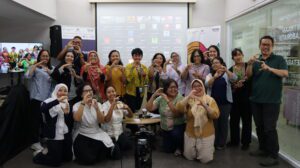
The Brown Bag Lunch is an internal learning and discussion forum initiated by the INKLUSI Secretariat for staff and CSO partners. It provides a space for knowledge exchange, critical reflection and cross-sector learning on issues relevant to program implementation.
Through this discussion, the study findings and partners’ experiences are expected to inform program strategies, strengthen evidence-based advocacy, and support more consistent GEDSI mainstreaming through meaningful collaboration between CSOs and government.