


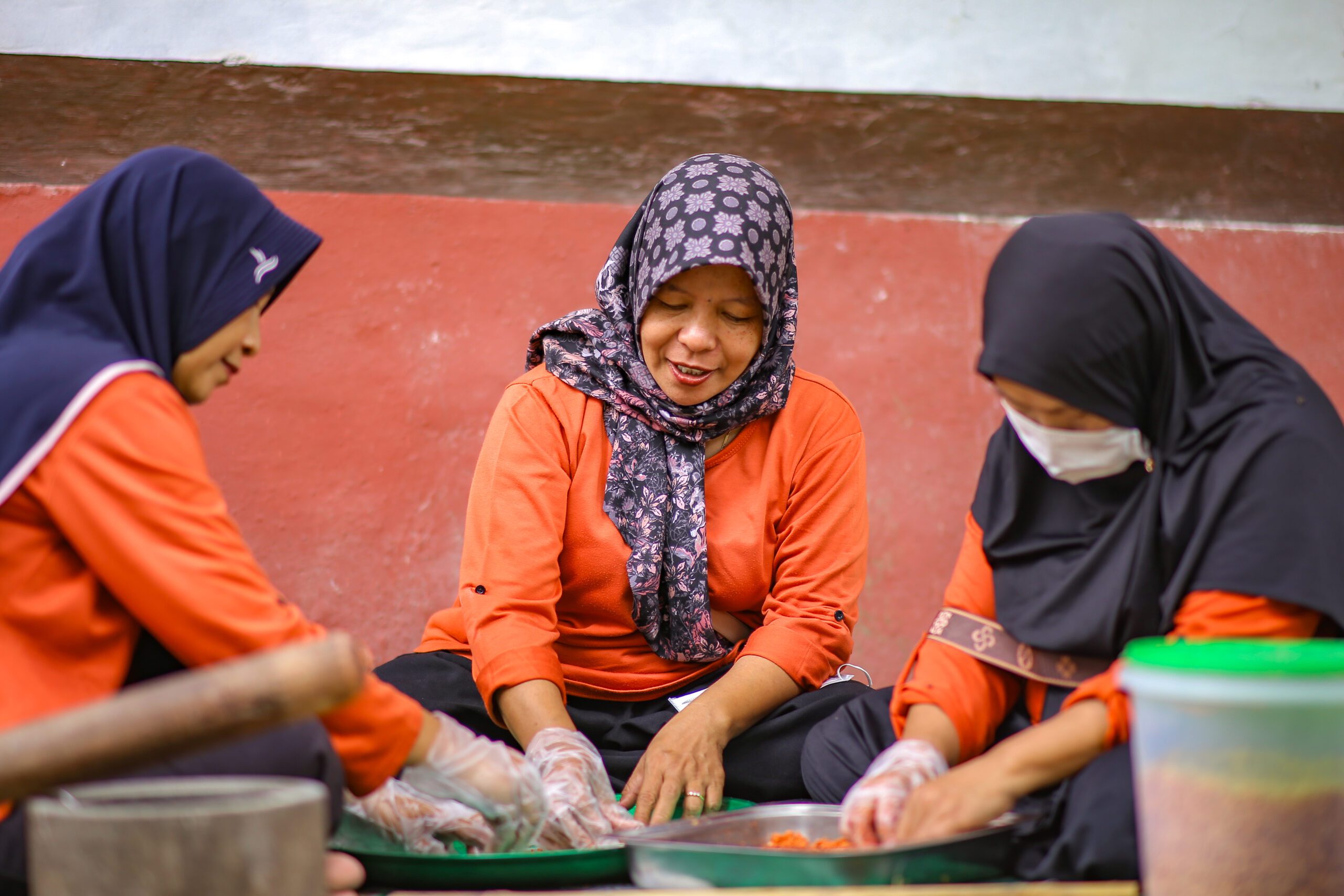
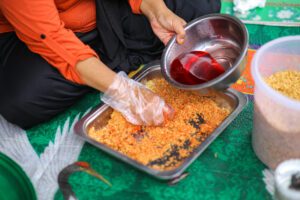
In a resident’s home in Lajut Village, East Lombok, a group of women divide up the work of making terasi, Indonesia’s fermented shrimp paste: cleaning small shrimp, pounding and grinding them, then drying the mixture in the sun. Their product, Terasi Lajut, has now become one of the village’s flagship products.
The group consists of former Indonesian migrant workers and their family members who are part of Desa Peduli Buruh Migran (DESBUMI), or Migrant Worker Care Village. With support from Migrant CARE, they established a collective enterprise producing terasi—made from fermented rebon shrimp and salt—as a new source of income after returning home.
The idea grew out of two simple realities: small shrimp were readily available locally, and terasi was a staple product used by households every day.
“Terasi is something people always need. Because the raw ingredients are also available around us, we decided to try making it together,” said Mairi, head of the DESBUMI business group in Lajut Village.
After learning from a local terasi producer, the group experimented with processing one kilogram of shrimp using a mortar and pestle, a manual grinder, and a small blender. The result was promising. Five members then contributed IDR 200,000 each, pooling around IDR 1 million to buy a blender and ingredients for their next production cycle.
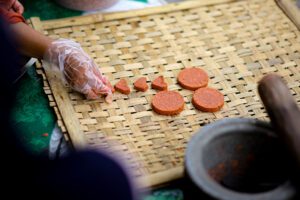
Production gradually increased from five kilograms of shrimp to several dozen kilograms when raw materials were available. Each stage—cleaning, grinding, drying and packaging—is done collectively, while proceeds are shared according to contribution: wages for those involved in production, a sales share for those marketing the product, and the remainder going into the group’s savings.
Through the process, members have learned more than how to make terasi. They have also become more accustomed to managing capital, sharing responsibilities, maintaining product quality and making decisions together.
From a Home-Based Business to Village Recognition
Initially sold to family members and nearby residents, Terasi Lajut is now marketed through WhatsApp and Facebook, at traditional markets, local bazaars and MSME events in the Mandalika area, and has even been shipped to Java. The name “Terasi Lajut” was chosen deliberately to make the product easy to recognise and closely associated with the village’s local potential.
“Terasi Lajut uses real shrimp and no preservatives. We want people to think of Lajut when they think of terasi,” Mairi said.
The changes are visible not only in increased production and wider marketing. Members who previously had little experience running a collective business have become more confident in planning production, dividing tasks, managing sales revenue and resolving problems as a group.
“Since joining the group, we have become more motivated. We have gained training, experience and new networks to help market our products,” said Raihana, a member of the DESBUMI business group.
Migrant CARE supports the group to identify local economic opportunities, strengthen the way the enterprise is organised, develop skills, expand marketing networks and build communication with the village government. Organising women through economic activities is also part of Migrant CARE’s broader strategy to strengthen the independence of former migrant workers, so they are in a stronger position to advocate for their rights and protection, as well as those of their families.
“Our strategy is to support members to become more independent, starting with economic independence by forming a group. Once they are more economically independent, we encourage them to advocate—for example, with the village government to access village funding and in the handling of cases,” said Tutik, a Migrant CARE field staff member in Lombok.
Consistent production and the visible benefits of the enterprise have gradually built the trust of the village government. The DESBUMI terasi has since been recognised as one of Lajut Village’s flagship products, with the village government providing training and two blenders to support production. Group members are no longer seen simply as beneficiaries, but as business operators contributing to the village economy.
“Once the village government can see the benefits, it becomes much easier to encourage support through the village budget,” Tutik said.
Migrant CARE’s support also extends beyond business development. DESBUMI members coordinate with the village’s integrated service post to connect residents with services they may need when facing problems related to migrant work.
Challenges remain. The availability of shrimp is seasonal, rain can disrupt the drying process, production capacity is still limited by reliance on household equipment, and facility requirements make it difficult for the group to obtain food production permits.