


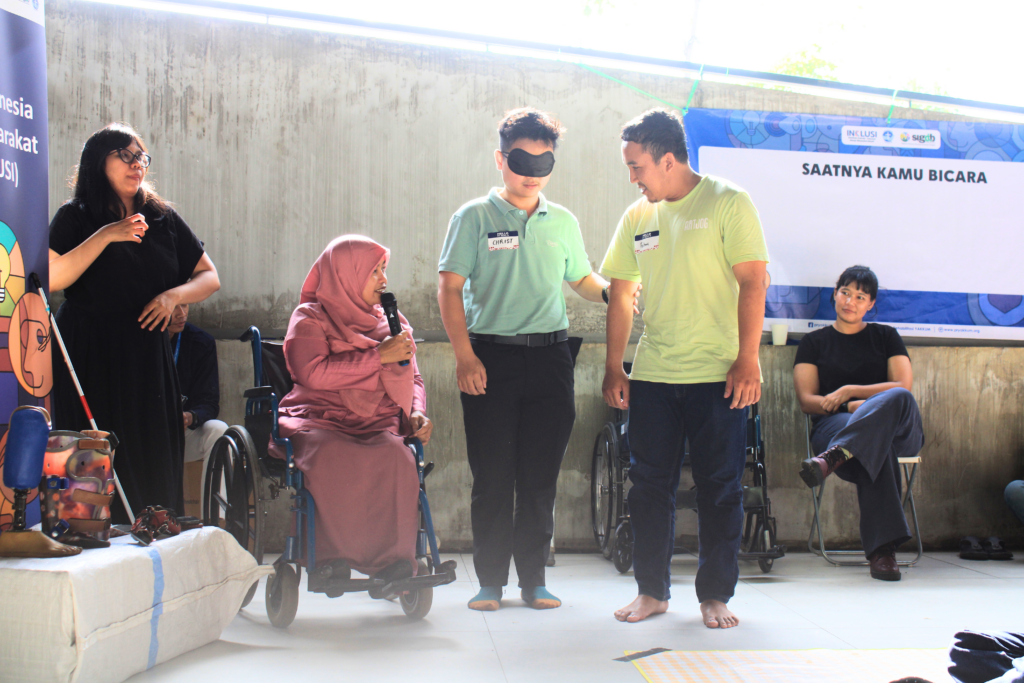
Jakarta, 24–25 January 2026 — On the second-floor corridor of the Trisno Soemardjo Building at Taman Ismail Marzuki (TIM), two young adult men took turns participating in a simulation of being a person with visual impairment. One acted as a guide, while the other covered his eyes with a blindfold. David, who took on the simulation, admitted he felt anxious from the start. Even with a guide beside him, he was still afraid to take each step. When the blindfold came off, his eyes welled with tears.
“I’ve only just realised how difficult it is to move around and feel safe in activities that many people consider simple,” he said.
David and 19 other participants enthusiastically joined a workshop hosted by INKLUSI partners SIGAB and PRYAKKUM, titled “Are Persons with Disabilities Truly Equal Citizens?”. Over three hours, participants were invited to understand different types of disabilities, learn appropriate interaction etiquette, and explore the barriers to accessing a decent quality of life—supported by hands-on simulations using assistive devices. Direct experiences like these can help make complex issues feel more tangible, concrete, and easier to understand.
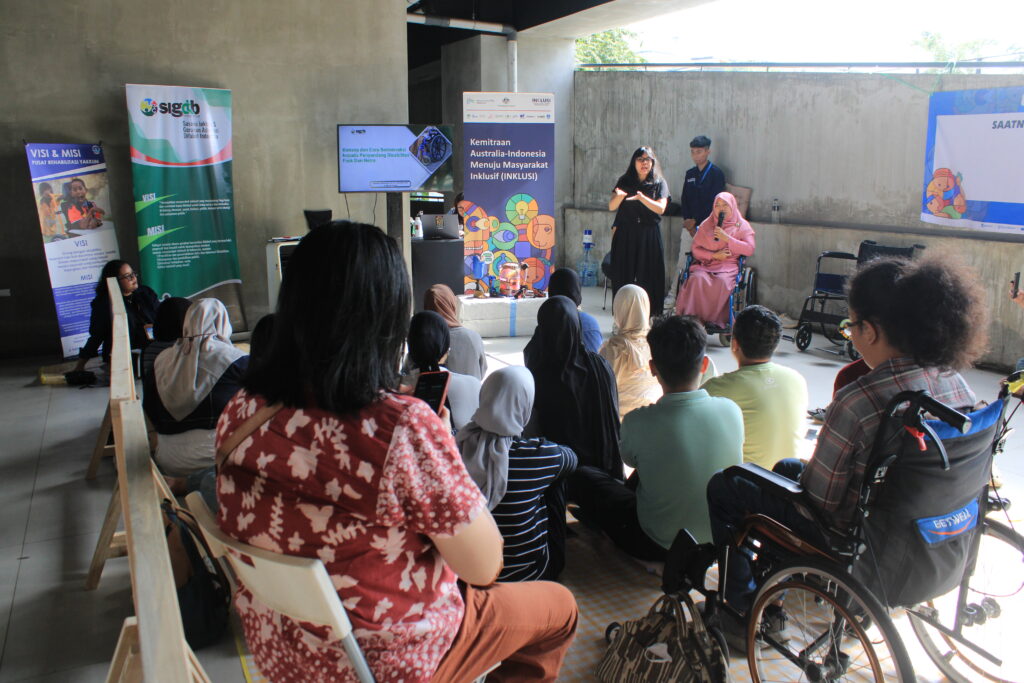
The partners’ participation in this festival was designed as part of broader efforts to expand public outreach and raise awareness on key social inclusion issues—ranging from disability inclusion and gender equality, to preventing child marriage and advancing migrant workers’ rights.
Pesta Pinggiran is a biennial social movement festival initiated by the media outlet Project Multatuli, envisioned as a relaxed space for social movements to share stories, creative work, and ideas, while celebrating both small and significant impacts that have been created. With the aim of bringing voices and actions from the margins into wider public spaces, the festival brings together civil society organisations, artists, and communities in a collaborative format. Over the two-day event, it was estimated to attract around 3,500 visitors.
“The activities brought by INKLUSI partners made Pesta Pinggiran richer and more inclusive,” said Yulia Sri Perdani, Collaboration Director at Project Multatuli.
In line with this, INKLUSI partners presented complex issues in participatory and accessible formats—through workshops, educational games, and open activations that allowed visitors to engage spontaneously. Beyond the workshop, eight INKLUSI partners staffed two Anti Brain Rot corners throughout the two days, using interactive activities to introduce each organisation’s focus. The relaxed, flexible format enabled visitors to drop by at any time, try activities, ask questions, and engage naturally—while still taking away new insights.
Featured activations included:
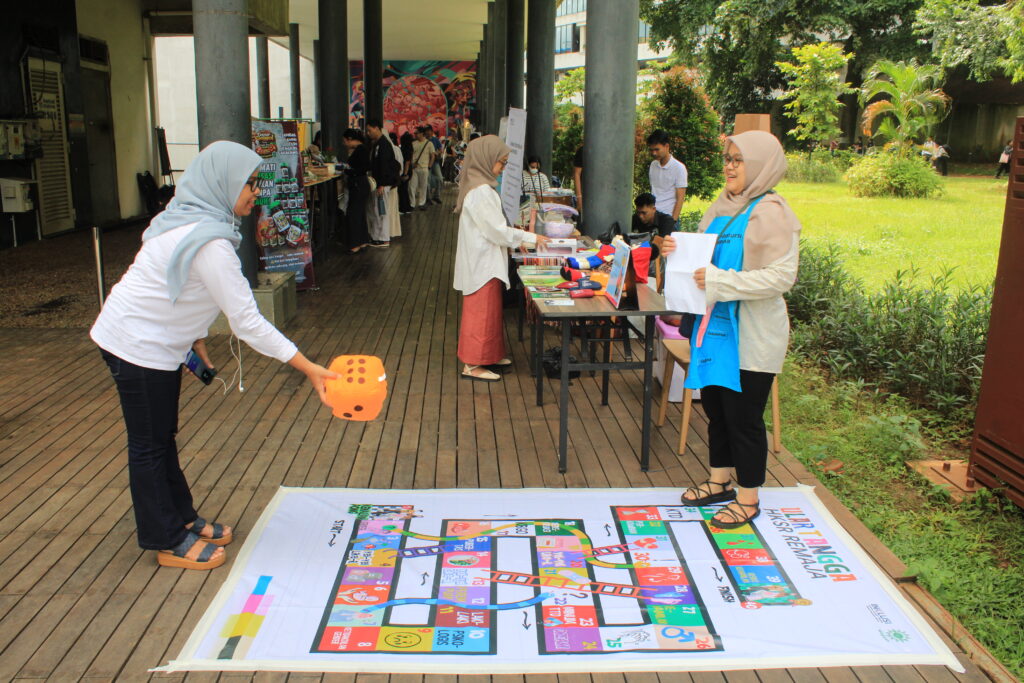
- ‘Aisyiyah: an interactive snakes-and-ladders game on Sexual and Reproductive Health and Rights (SRHR);
- Institut KAPAL Perempuan: Q&A cards and an educational snakes-and-ladders game on gender justice;
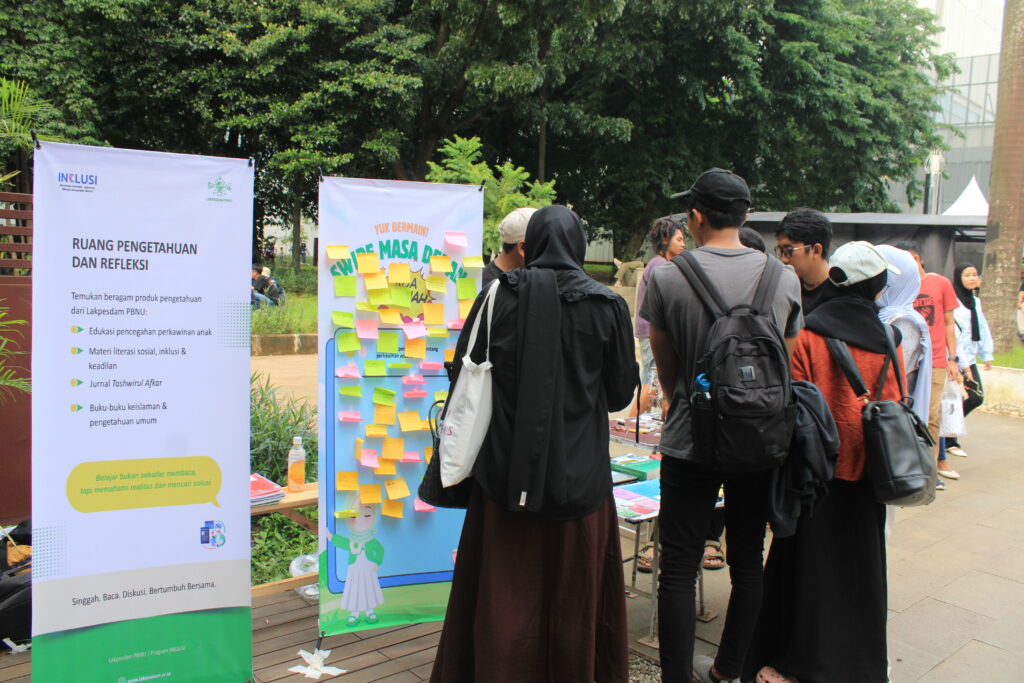
- Lakpesdam PBNU: “Swipe from the Future”, a simulation on the impacts of child marriage;
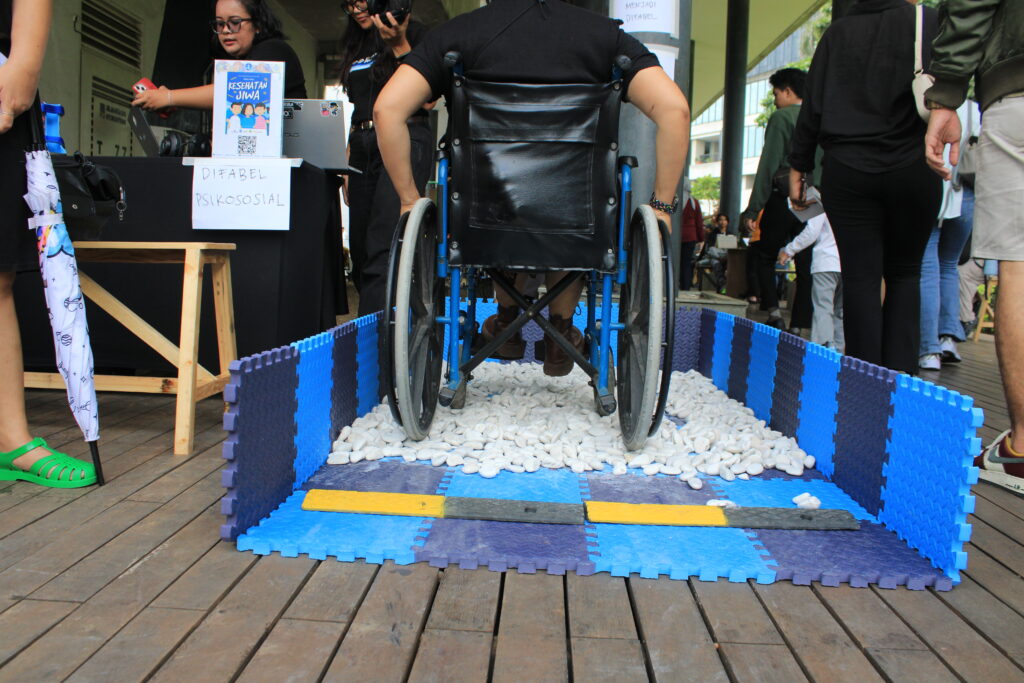
- SIGAB: a wheelchair-route simulation and an interactive sign language class;
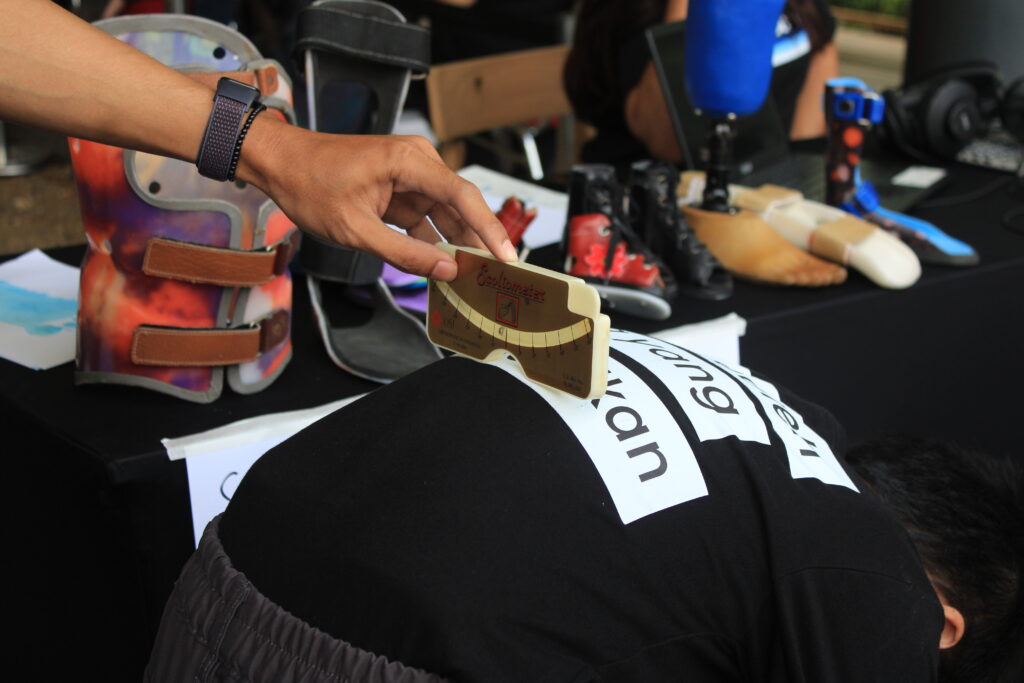
- PRYAKKUM: an assistive device display, psychosocial disability simulation, and scoliosis and flat feet checks;
- PEKKA and PKBI: community products such as handicrafts and food;
- MigrantCARE: a poetry performance of “Ratapan Tangis TKW” by the Desbumi Community of Sindupaten Village (24 January), accompanied by guitar and supported by a Sign Language Interpreter.
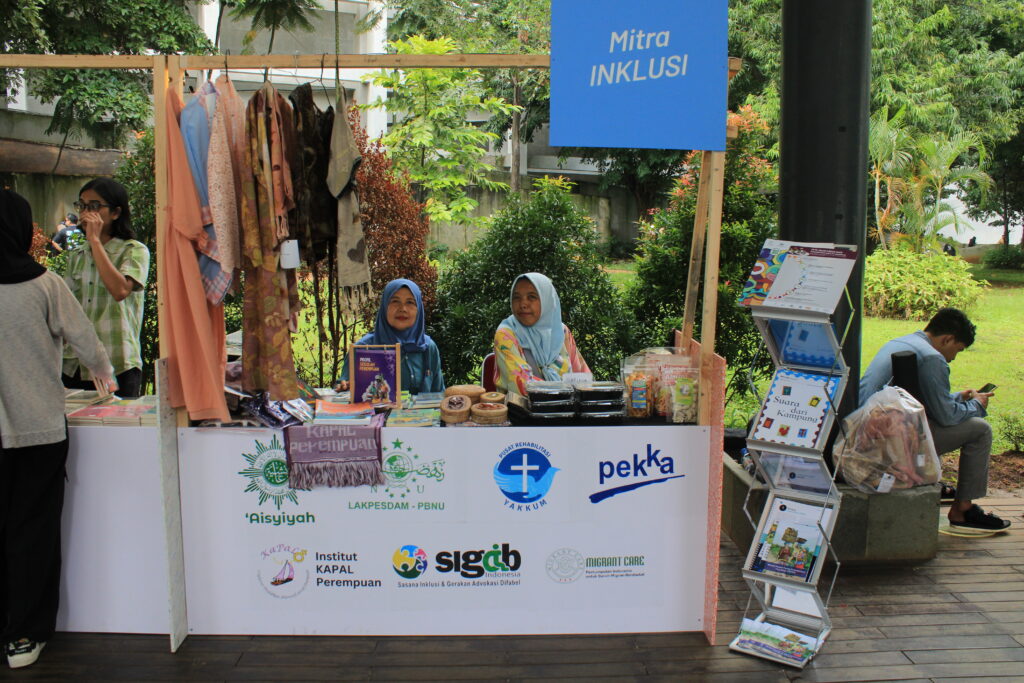
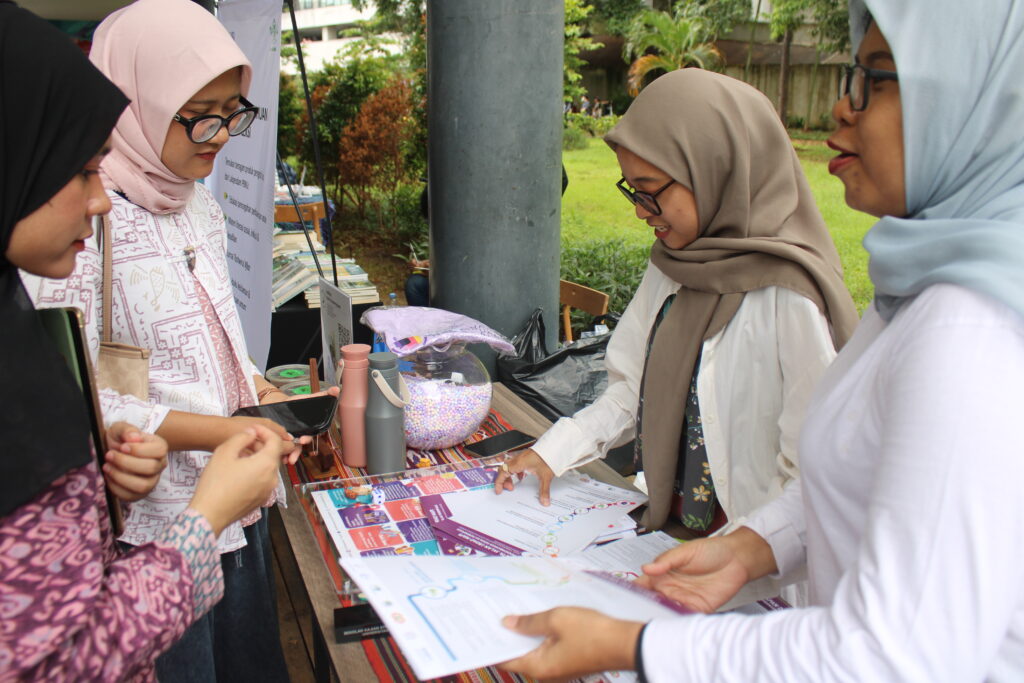
This series of activations demonstrated how advocacy issues can be presented in audience-friendly ways without reducing their substance. In the wheelchair simulation area, for example, several visitors who tried navigating a gravel route said they had only then realised how difficult it can be to move through public spaces when accessibility is not planned from the outset. Awareness like this often comes not from information alone, but from experiences that prompt people to pause and reconsider everyday realities.
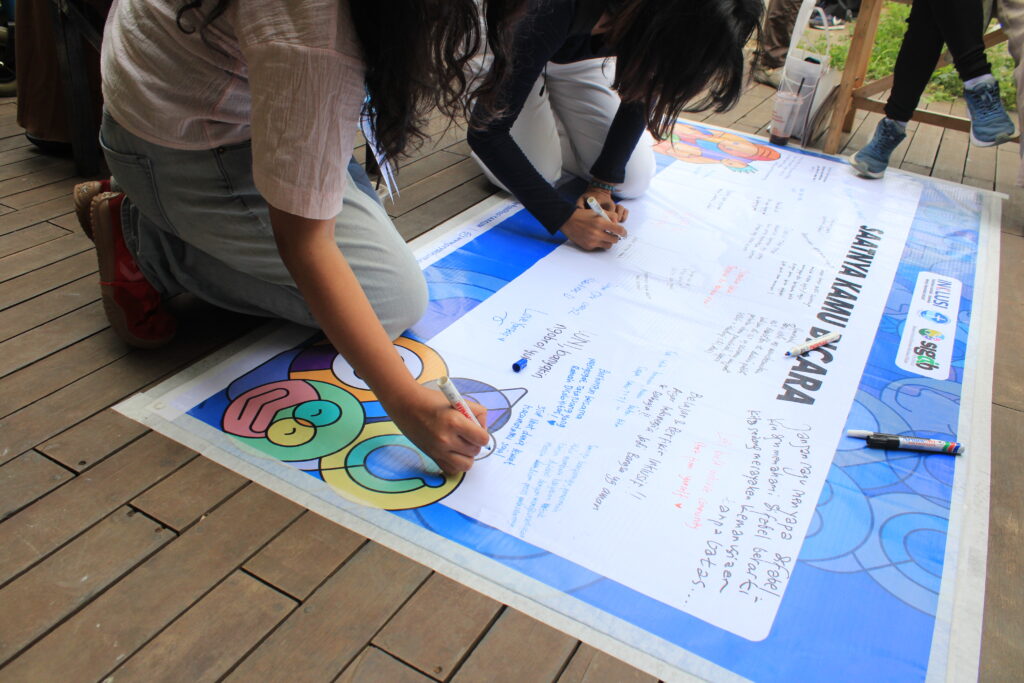
Alfitra Yosi Putrijaya from PRYAKKUM expressed appreciation for the opportunity to collaborate in a public setting. She said, this first experience of communicating disability issues in a lighter, more approachable format proved effective and was well received by visitors, while also strengthening the organisation’s role as an ecosystem builder.
“We see this experience as strengthening our capacity as an ecosystem builder, including developing new approaches to organisational branding and encouraging more stakeholders to become involved in fulfilling the rights of people with psychosocial disabilities (ODDP),” Alfitra said.