

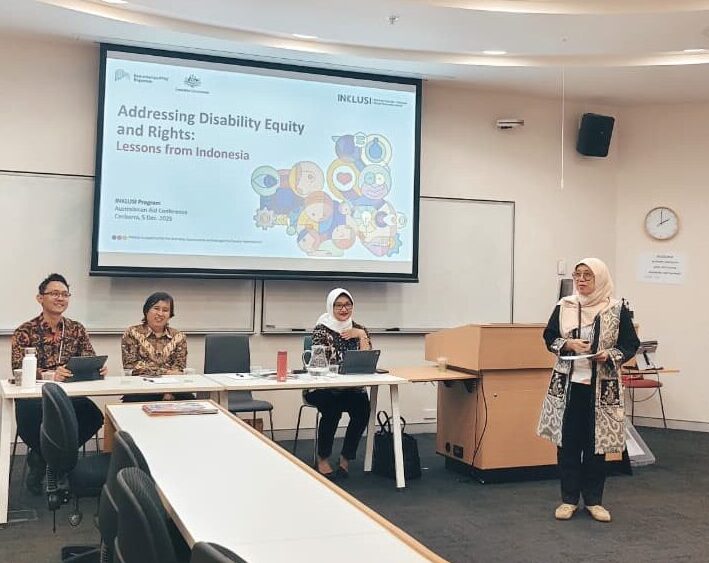
Canberra, 5 December 2025 – INKLUSI partners took part in the Australasian AID Conference (AAC) 2025 in Canberra through a dedicated session themed “Addressing disability equity and rights: lessons from Indonesia.” The session brought Indonesian government and civil society voices into the same room to share practical experiences—what has worked, what remains challenging, and what it takes to turn disability rights into everyday access to services, jobs, and dignity.
AAC is an annual forum held by the Australian National University’s (ANU) Crawford School of Public Policy in Canberra in partnership with The Asia Foundation. It brings together researchers and practitioners working on aid and international development policy to exchange evidence and strengthen collaboration. This year, the conference was held on 3–5 December at the ANU in Canberra.
The INKLUSI-related session was scheduled on 5 December, reflecting growing interest in inclusion and disability equity within development debates across the region. The discussion highlighted how disability-inclusive development can be advanced through the combination of national planning frameworks, community-led organising, and rights-based services—showing the value of partnerships between government and civil society.
The session brought together Tirta Sutedjo (Director for Poverty Alleviation and Social Welfare, Ministry of National Development Planning/Bappenas), Dr. Tri Hastuti Nur Rochimah (Secretary-General of the National Board of ‘Aisyiyah, Indonesia), M. Joni Yulianto (Executive Director, SIGAB Indonesia), and M. Aditya Setiawan (Head of Holistic Rehabilitation Program, YAKKUM Rehabilitation Center).
Bappenas first set the policy context, outlining how disability inclusion is being embedded in national planning and basic services—emphasising the role of data, regulations, and planning tools to fulfil the rights of persons with disabilities across sectors. The presentation highlighted Indonesia’s policy architecture and planning instruments designed to support cross-sector implementation, aligning disability inclusion with broader national development priorities.
From there, INKLUSI partners grounded the discussion in lived realities and community practice. ‘Aisyiyah shared how inclusive employment pathways can be built earlier—starting in schools—through coordination between special schools (SLB), families, local government, and employers. A featured story followed Lutfi, who applied to a company after receiving job readiness support and was hired for his first formal job, showing how confidence-building, teacher support, and employer engagement can unlock opportunities that stigma often blocks.
SIGAB Indonesia highlighted community organising through KDK/KDD (People with Disabilities Groups at village/kelurahan level). These groups support participatory disability mapping, open access to village planning and budgeting forums such as Musrenbang, and help drive local policy change through village decrees and regulations—so disabled people move from being “last to be seen and last to be heard” to becoming influential in local decision-making.
PR YAKKUM brought attention to psychosocial disabilities and the urgency of preventing and ending pasung (shackling) through rights-based, community-led support. Using Mama Gina’s story, the presentation illustrated how self-help groups and family education can reduce fear and stigma, reconnect people with their communities, and restore dignity—while underscoring the need to better integrate psychosocial disability into health, social protection, and local development policies.
The key takeaway from INKLUSI partners’ participation at AAC 2025 was clear: disability inclusion advances fastest when national planning commitments are linked to community-led solutions—and when government and civil society collaborate to translate rights into real access, opportunities, and protections in daily life.
By bringing Bappenas and INKLUSI partners into the same AAC conversation, the session demonstrated how disability-inclusive development is strengthened when national planning commitments meet community-led solutions—and when government and civil society collaborate to translate policy into accessible services, opportunities, and rights in daily life.