

Disasters do not affect everyone in the same way. In flood situations, women and girls often face heavier burdens: loss of livelihoods, increased care work, limited access to basic services and healthcare, and heightened risks of gender-based violence. These vulnerabilities become even more acute for women with disabilities, Indigenous women, older women, women heads of households, and other at-risk groups.
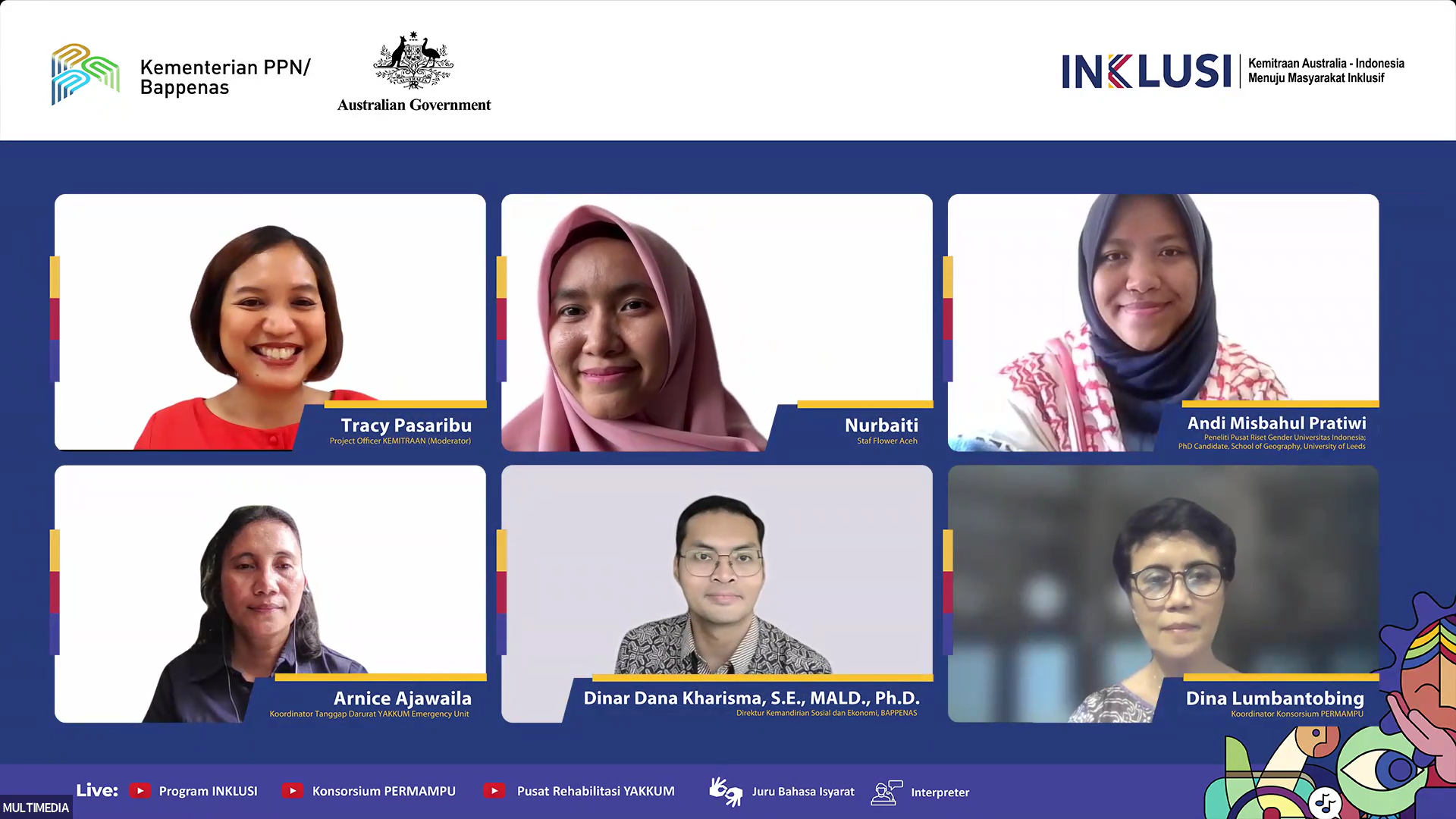
These issues were explored in Bincang INKLUSI, themed “Grassroots Women’s Movements in Inclusive Disaster Response”, held on 13 March 2026 in commemoration of International Women’s Day. The online discussion brought together community experiences, frontline facilitators, government, and academics to examine how disaster response can be made more just and inclusive.
In her opening remarks, INKLUSI Team Leader Kate Shanahan stressed that grassroots women are not only those affected by disasters.
“Grassroots women’s organisations actively reach those most in need and support social and economic recovery,” she said.
That reality was vividly reflected in the story of Nurbaiti, a field staff member of Flower Aceh and a flood survivor from Aceh Tamiang several months ago. She described how flash floods forced her to move between evacuation sites three times in one night, evacuate her young twin children, and endure separation from her husband for three days and three nights.
In the midst of darkness and limited resources, she still thought about others in the evacuation shelter—older people, those who were ill, and needs that are often seen as small but are in fact essential. “We supported one another. In times of disaster, we cannot survive alone,” said Nurbaiti.
Her experience shows that community solidarity is often the first line of support when formal systems have not yet been able to reach everyone’s needs.
Bincang INKLUSI: Inclusive Response Must Begin with Real Needs
Dina Lumban Tobing, Coordinator of PESADA PERMAMPU, emphasised that the first step taken by her network was not immediately distributing aid, but collecting disaggregated data. In her view, women are not a homogeneous group, and therefore the impacts of disasters and their recovery needs also differ.
She gave examples from PERMAMPU’s areas of work, where women lost not only their homes, but also their livelihoods, access to health services, and sense of safety. In Central Tapanuli, relocation was not simply a matter of moving people elsewhere; it also touched on identity and ancestral ties.
“The issue of a village disappearing is not that simple. Relocation is not that easy,” Dina said.
She also underscored that recovery efforts must create space for women to define their own needs, rather than merely accept decisions made by others.
Highlighting psychosocial disabilities and barriers to access in disaster situations, Arnice Ajawaila from the YAKKUM Emergency Unit said that stress, anxiety, and feelings of helplessness cannot be separated from disrupted access to basic needs. Yet assistance often fails to reach those who need it most because data is unavailable or outdated.
“The main challenge is that many of them are not recorded. Stigma remains widespread. Data about them is absent in disaster situations,” Arnice said.
She stressed that assistance must not only be available, but also accessible, well-targeted, and built with the support of families and communities.
From a policy perspective, Dinar Dana Kharisma, Director of Social and Economic Self-Reliance at Bappenas, emphasised that social assistance and empowerment programmes must be responsive to the specific vulnerabilities and barriers faced by each group. He reminded participants that vulnerability is not a static condition.
“The government must be responsive when dynamics shift—by anticipating changes quickly, providing appropriate programmes, or building preparedness from the outset,” he said, adding that while data is important, the capacity to use that data in policy planning is equally crucial.
Meanwhile, Andi Misbahul Pratiwi, a researcher from the Centre for Gender Studies at Universitas Indonesia, invited participants to see that disasters are not neutral events. Disasters do not create inequality—but they do intensify it, she said. She explained that before, during, and after disasters, high-risk groups are often labelled as “vulnerable” without being meaningfully involved in decision-making.
“An inclusive disaster approach must create safe spaces, listen to local knowledge, and ensure that affected groups have a say in shaping the direction of recovery,” Andi said.
This edition of Bincang INKLUSI reaffirmed that grassroots women are not merely survivors. They are the driving force that keeps life going in the midst of crisis. The challenge now is to ensure that their experiences, knowledge, and leadership are genuinely recognised and supported through policies, services, and cross-sector coordination that are responsive to gender, disability, and social inclusion.